A breast cancer diagnosis can bring a flood of questions. What happens next? Will I need surgery? What treatment options are available? Will I still look and feel like myself after treatment?
Advances in breast surgery are helping answer those questions with new techniques designed to treat cancer while also supporting recovery, comfort and quality of life.
At Community Health Network MD Anderson Cancer Center, that includes single-port robotic-assisted breast surgery, an innovative mastectomy option designed to help patients heal faster with less visible scarring.
"It's truly a privilege to be one of the few centers in the country to offer this technique to patients," said Dr. Joshua Manghelli, a breast surgical oncologist trained in robotic surgery with Community Health Network. "I firmly believe it's a better operation and results in better outcomes."
Small Incision, Big Questions
New technology can open the door to new possibilities, but it can also raise questions. In this Q&A, Dr. Manghelli breaks down what patients should know about the procedure and what it could mean for their experience before, during and after surgery.
What Is Single-Port Robotic-Assisted Breast Surgery?
Let's start with the basics. Single-port robotic-assisted breast surgery, also called single-port robotic nipple-sparing mastectomy or robotic mastectomy, is a minimally invasive approach that uses advanced robotic technology to help a specially trained surgeon remove breast tissue through a single, small incision.
Although it's one of the newer advancements in breast cancer surgery, the idea behind it is simple: treat cancer effectively while reducing some of the physical reminders surgery can leave behind.
Built on robotic technology that's been used in operating rooms for years, the single-port approach was designed to help surgeons work through a smaller incision while preserving as much healthy tissue as possible. The result is a technique that may offer less visible scarring, improved sensation preservation and a less painful recovery process.
Wait — Does a Robot Actually Perform the Surgery?
These days, robots can do just about everything, from vacuuming floors to driving cars and delivering packages. So when you hear "robotic surgery," it's easy to envision a scene straight out of The Jetsons.
But no — the robot isn't making decisions or performing surgery on its own.
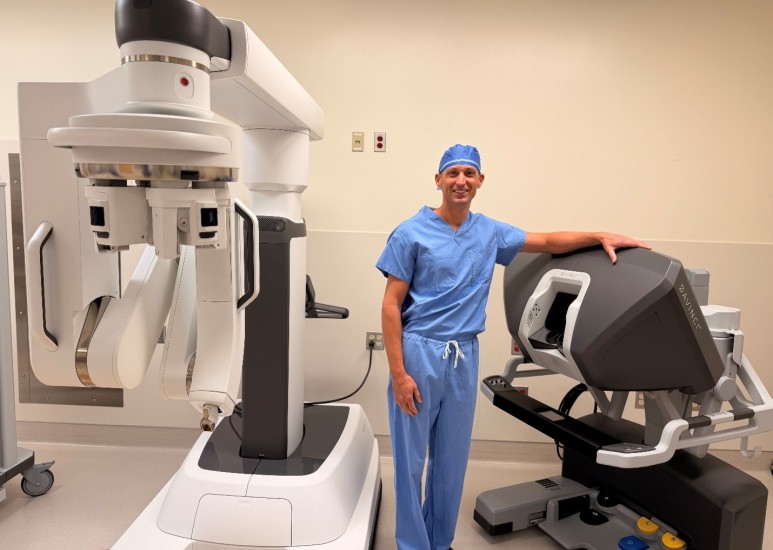
"A common misconception is that an actual robot is doing the operation when in reality, I'm sitting at a console controlling four robotic arms that ultimately help me accomplish the surgery in a much smaller space," Manghelli explains.
Think of it as an extension of Dr. Manghelli's hands. He controls the instruments throughout the procedure while the technology provides enhanced visualization and precision.
Does Single-Port Robotic-Assisted Breast Surgery Leave a Noticeable Scar?
Scarring is a common concern for patients considering breast cancer surgery. Traditional surgery techniques often involve noticeable incisions in the breast and produce visible scarring. But one of the unique aspects of this procedure is where the incision is placed. Instead of being made on the breast, it's typically hidden in the armpit.
Robotic surgery also enables surgeons to access difficult-to-reach areas with more precision, which can result in a smaller incision and a less noticeable scar.
"With a standard open nipple-sparing mastectomy, we generally make incisions that range from 5 to 11 centimeters. This minimally invasive option allows for a 3-centimeter incision," Dr. Manghelli says.
Can Robotic-Assisted Breast Surgery Help Preserve Sensation?
Yes!
"The biggest benefit in my eyes is that the majority of patients are retaining sensation to the breasts and the nipple, which does not happen after an open nipple-sparing mastectomy approach," Dr. Manghelli says. "This technique allows the surgeon to be more precise and delicate with the tissue, which I think overall results in improved sensation compared to standard surgical approaches."
Can It Support a More Natural-Looking Result?
For many patients, it's not just about what cancer treatment removes but what can be preserved. When combined with immediate breast reconstruction, robotic-assisted breast surgery helps preserve healthy skin and tissue while keeping the incision away from the breast itself. The result is a more natural-looking appearance after surgery.
For Dr. Manghelli, the cosmetic benefit is about more than appearance.
"Most centers place a tissue expander following mastectomy, which means the patient will have to go back to the operating room several months later for an additional operation for reconstruction. With the robot we are able to reconstruct the breast at the first operation so a tissue expander is not needed. All of these things together result in a better quality of life for our patients."
Could It Mean Less Pain and Faster Recovery?
Nobody wants to spend more time recovering than necessary. Because of the smaller incision, there may be less pain to manage and a faster timeframe for healing. For patients who are candidates, this can mean getting back to the people, routines and activities that matter most sooner.
Dr. Manghelli comments, "This approach ultimately results in less healing time and postoperative pain for the patient."
How Is Robotic-Assisted Breast Surgery Different from Traditional Mastectomy?
Both techniques have the same goal: removing breast tissue as a part of cancer treatment, or in some cases, reducing the risk of developing breast cancer. The main difference is how the surgery is performed and what recovery may look like.
Single-Port Robotic-Assisted Surgery
- Incision: Single 3 cm incision, typically hidden in the armpit
- Scarring: Scar may be less noticeable due to smaller, hidden incision
- Sensation: May offer the possibility of preserving breast and nipple sensation
- Reconstruction: Supports nipple-sparing surgery and immediate reconstruction
- Recovery: May result in less postoperative pain and a shorter healing time
- Best for: Select patients who are candidates for nipple-sparing robotic surgery
Traditional Mastectomy
- Incision: Larger incision on or around the breast
- Scarring: More visible scar on the breast or chest
- Sensation: Sensation is typically not preserved or is significantly altered
- Reconstruction: Can also be paired with reconstruction, depending on the patient’s situation
- Recovery: Standard recovery and healing time
- Best for: Patients whose anatomy, cancer type or treatment needs require a traditional approach
And it's not limited to patients who have already been diagnosed with breast cancer.
"This isn't a technique that's just for breast cancer patients," Manghelli adds. "For patients who are genetically predisposed to breast cancer, we often do preventive surgeries. And this is a great technique for mastectomy for them as well."
This means some patients with an increased genetic risk of breast cancer who choose a preventive mastectomy may also be candidates for the procedure.
Is Single-Port Robotic-Assisted Breast Surgery Right for Everyone?
The best surgical approach is the one that fits your diagnosis and goals. Single-port robotic-assisted breast surgery can offer meaningful benefits, but it is not the right option for every patient. Your care team will consider several factors when determining whether this approach may be appropriate, including:
- The type and location of the cancer
- Breast anatomy
- Overall health
- Treatment and recovery goals
Dr. Manghelli emphasizes that the best surgical approach depends on the individual patient.
"We work closely with each patient to review their options and find the treatment plan that's right for them," he says.
At Community Health Network MD Anderson Cancer Center, breast surgeons take the full picture into account when recommending a care plan. They will walk you through your options, explain what each approach could mean for treatment and recovery, and help determine which option best supports your individual needs.
If robotic-assisted surgery is not the right fit, traditional breast surgery and other treatment options remain safe, effective choices for many patients.
Advanced Breast Cancer Care, Close to Home
A breast cancer diagnosis doesn't come with easy answers, but having more options can make a meaningful difference. For patients in Indianapolis, innovative approaches like robotic-assisted breast surgery are expanding what's possible.
Because when you're facing breast cancer surgery, it's not just about getting through treatment. It's about moving forward with confidence and feeling more like yourself.
"This technology represents another step forward in providing patients with access to advanced treatment options close to home," Manghelli says.
To learn more about breast surgery options at Community Health Network MD Anderson Cancer Center or to schedule a consultation or second opinion, visit eCommunity.com/breastsurgery or call 877-655-9599.
Joshua Manghelli, DO, Board-Certified Breast Surgical Oncologist

Dr. Joshua Manghelli is a board-certified breast surgeon trained in robotic surgery who devotes his practice to the diagnosis and management of all breast health issues, from benign disease to breast cancer. As a Community Health Network MD Anderson Cancer Center participating provider, he offers individualized treatment tailored to specific cancers along with a multidisciplinary team of highly specialized cancer care experts. He is available for second opinions to offer peace of mind or additional treatment options.
Dr. Manghelli attended medical school at A.T. Still University in Missouri. He then completed general surgery residency and breast surgical oncology fellowship at Indiana University School of Medicine. Dr. Manghelli is board certified in general surgery and is a member of the American Society of Breast Surgeons.
Dr. Manghelli enjoys spending time with his wife and children. In his spare time, he enjoys flying planes, slalom water skiing and running.