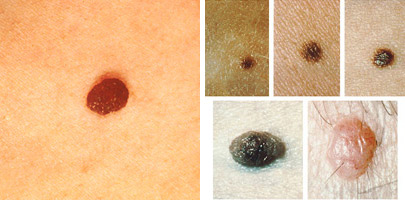
Knowing what a typical mole looks like is the first step in protecting your skin. Most people have moles, which often develop from childhood through age 40. After age 40, new moles are less common, and existing moles may fade with age.
A normal, or "common," mole is usually a small, harmless growth on the skin that stays the same for years. Healthy moles typically share these characteristics:
Uniform Color: Usually a single shade of tan, brown or black.
Symmetry: Typically round or oval with a balanced shape.
Defined Borders: Edges are clear and well-defined from the surrounding skin.
Some examples of normal moles are shown below.
A collection of healthy moles showing uniform brown color, symmetrical round shapes, and clearly defined borders.
Because common moles tend to remain stable over time, changes in size, shape, color, or texture may be a sign to have your skin checked by a medical professional.
How To Identify Skin Cancer: the ABCDE Rule
An easy-to-remember rule for recognizing potential skin cancer is the ABCDE rule. Perform a monthly skin self-exam to help you notice changes early. If you observe any of the following characteristics, schedule an exam with a medical professional.
Asymmetry: One half of the mole does not match the other half.
Border: Edges that are uneven, notched, scalloped, blurred or irregular.
Color: Multiple colors or uneven color distribution in one mole, including shades of tan, brown, black, blue, white or red.
Diameter: A spot wider than ¼ inch (6 millimeters), or about the size of a pencil eraser.
Evolving: Spots that change in size, shape or color over time or look “different” from others.
Not all changing moles are cancerous, but checking changes early gives you the best chance for successful treatment.
Other Warning Signs of Skin Cancer
Not all melanomas and other types of skin cancer follow the ABCDE rule. If you notice any unusual changes to your skin, it’s important to have them evaluated by a medical professional—even if they don’t fit the typical pattern.
Contact your doctor if you notice any of the following signs or symptoms:
Non-Healing Sores: A sore that bleeds, crusts, or does not heal after several weeks.
Pigment Spread: Color, darkening or redness that extends beyond the border of a mole or spot into the surrounding skin.
New Sensations: A spot that begins to itch, tingle, hurt or feel tender.
Texture Changes: Surface changes such as oozing, bleeding, scaliness or the development of new bumps or nodules.
High Number of Moles: Having many moles — especially 50 or more — which may increase melanoma risk.
The "Ugly Duckling" Sign: A mole or spot that looks noticeably different from others on your body in color, size or shape.
When To See a Doctor
Most moles are harmless, but early detection can lead to successful treatment of skin cancer. Schedule a professional skin exam if you notice:
Any mole that meets the ABCDE criteria, including changes in asymmetry, border, color, diameter or evolution.
A new or existing spot that is changing, itching, bleeding or not healing.
An "Ugly Duckling" spot that stands out from the other moles or marks on your body.
To protect your skin and your peace of mind call 800-777-7775 to schedule a skin cancer screening with a Community dermatologist.
Community offers free skin cancer screenings in the month of May at our Community MD Anderson Cancer Centers. Appointments are limited. Find a date and location.
Skin Cancer Screening FAQs
How often should I check my skin for the ABCDE signs?
We recommend performing a skin self-exam once a month. Monthly checks help you become familiar with what's normal for your skin so you can more easily notice new or changing moles or spots over time.
Can a mole be cancerous if it doesn’t follow the ABCDE rule?
Yes. While the ABCDE rule is a helpful guide, some melanomas and other skin cancers do not follow these patterns. That’s why paying attention to the "Ugly Duckling" sign and scheduling professional skin cancer screenings are so important.
What happens during a professional skin cancer screening?
During a professional skin cancer screening, a dermatologist performs a head-to-toe visual examination of your skin. This includes commonly overlooked areas, such as the scalp, ears and the soles of the feet. Screenings are quick and non-invasive and help identify skin cancer at its earliest and most treatable stages.
How do I prepare for a skin cancer screening?
To prepare for your skin cancer screening, remove any nail polish and be ready to point out any moles or spots you've noticed changing. Wearing loose-fitting clothing can also make your exam more comfortable.
Do skin cancer screenings hurt?
No. Skin cancer screenings are painless and non-invasive. The exam involves a visual inspection only and does not require needles or procedures.